Before we start, every "-" is mine. I used them before AI and they are a habit in my writing. AI uses them because they are technically correct. I am too old to change just because people who never used them now scream "AI." AI was used in writing this. I record the article as if I am giving a presentation, AI transcribes it, I edit and draft, and then it does the final pass before publishing.
I was going to write this article several days ago as an interesting speculation about a tiny company doing something completely different.
Then AMD bought it.
Apparently, I was not the only person who thought this might be important. I guess even a broken clock is right twice a day.
The company is Taalas, and it has done something that sounds almost ridiculous when you first hear it. It turned an AI model into silicon. I do not mean that it stored a model on a chip beside a processor. That would be fast storage. Taalas did something much more extreme. The chip is the model.
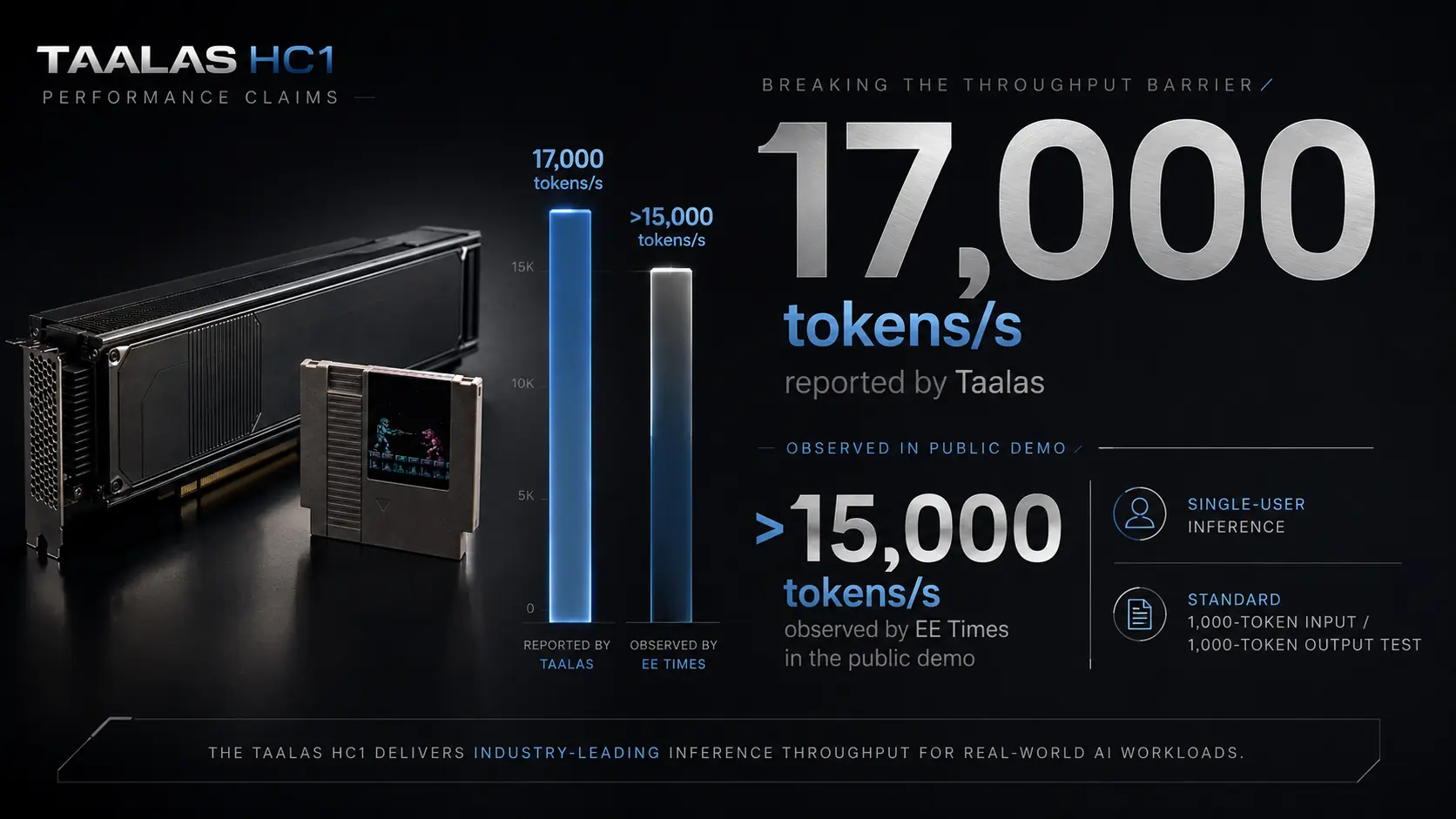
Its first technology demonstrator physically implements Llama 3.1 8B, including the model weights and much of the dataflow used to run it. The result generates approximately 17,000 tokens per second for a single user. Not 17,000 tokens per second spread across a giant batch of users. For one user.
At that speed, streaming the response is pointless. You ask a question and the answer essentially appears at once. The public demo is called ChatJimmy, and it feels less like a very fast chatbot than a website that somehow knew the answer before you finished clicking the button.
This is not a theoretical simulation. Taalas built the chip. It is running. EE Times saw more than 15,000 tokens per second while trying the public system, and Taalas reports results closer to 17,000 under its standard 1,000-token-input, 1,000-token-output test. Taalas published the system details, and EE Times interviewed the engineers behind it.
There are very large catches. We will get to those.
First, it is worth understanding why this works at all.
We keep moving the same model over and over again
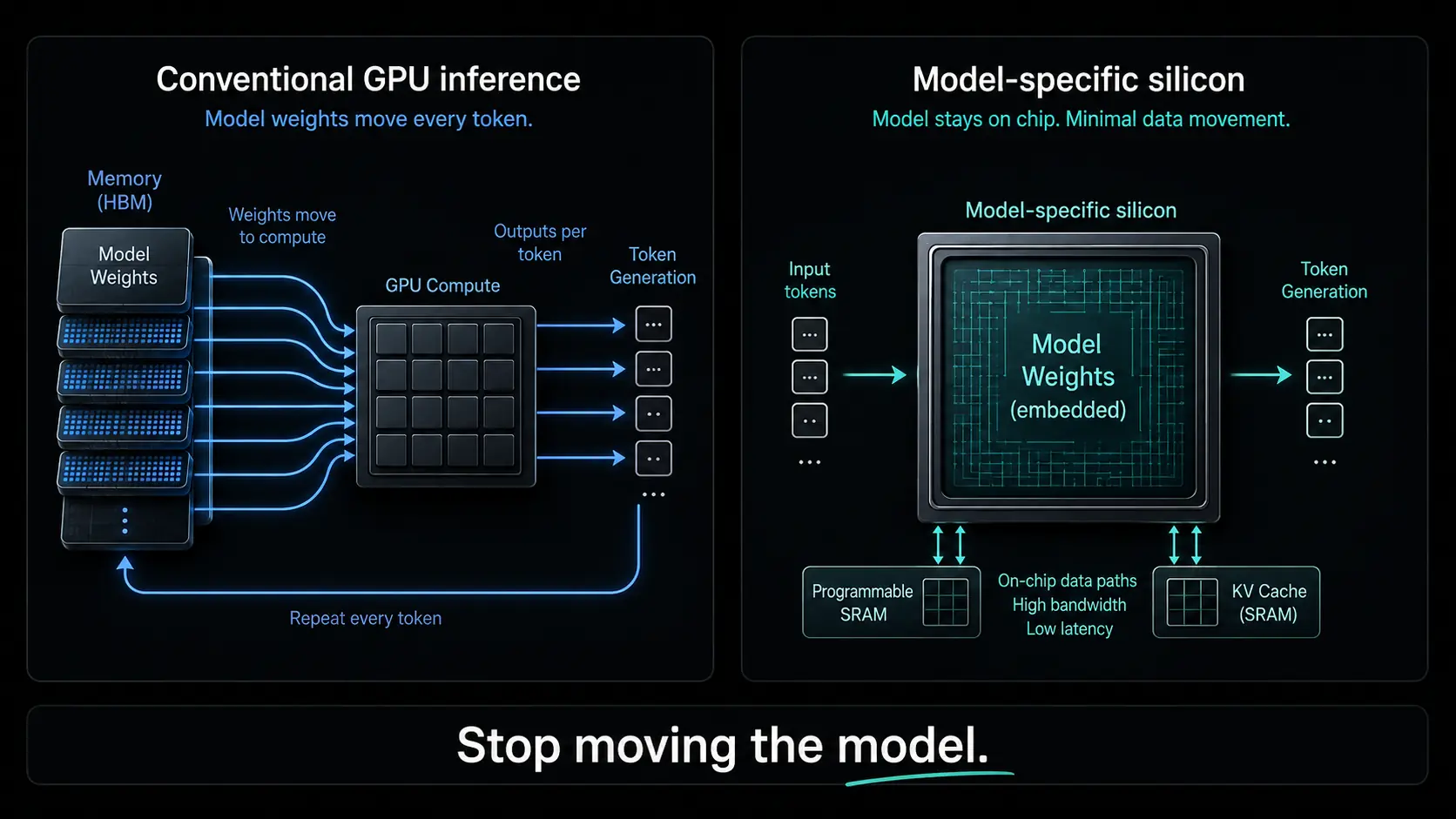
Modern GPUs are astonishingly good at math. Unfortunately, running a large language model is not only a math problem. It is also a moving-things-around problem. Every time a model generates a token, the accelerator has to work through billions of parameters. Those weights normally live in high-bandwidth memory. The GPU repeatedly moves them from memory into its compute units, performs the necessary operations, and then does it all again for the next token. The model may not change between tokens, but we keep hauling it past the compute anyway.
This is the memory wall. It is why AI accelerators need enormous amounts of HBM, absurd memory bandwidth, advanced packaging, very fast interconnects, increasingly complicated cooling and enough power infrastructure to make utilities reconsider their life choices.
I own a 96 GB RTX PRO 6000 Blackwell that cost an eye-opening amount and can consume 600 watts by itself. It is an incredible piece of hardware. It is also a general-purpose accelerator dragging model weights out of memory for every token like every other GPU.
Everyone in AI is attacking this problem. NVIDIA, AMD, Google, Groq and an army of startups are building faster compute, faster memory, larger memory, more efficient dataflow and better ways to connect increasingly large groups of chips. Software projects are improving kernels, quantization, batching, caching, speculative decoding and every other layer of the stack.
Taalas looked at all of that and asked a different question:
What if we stop moving the model?
The model is the computer
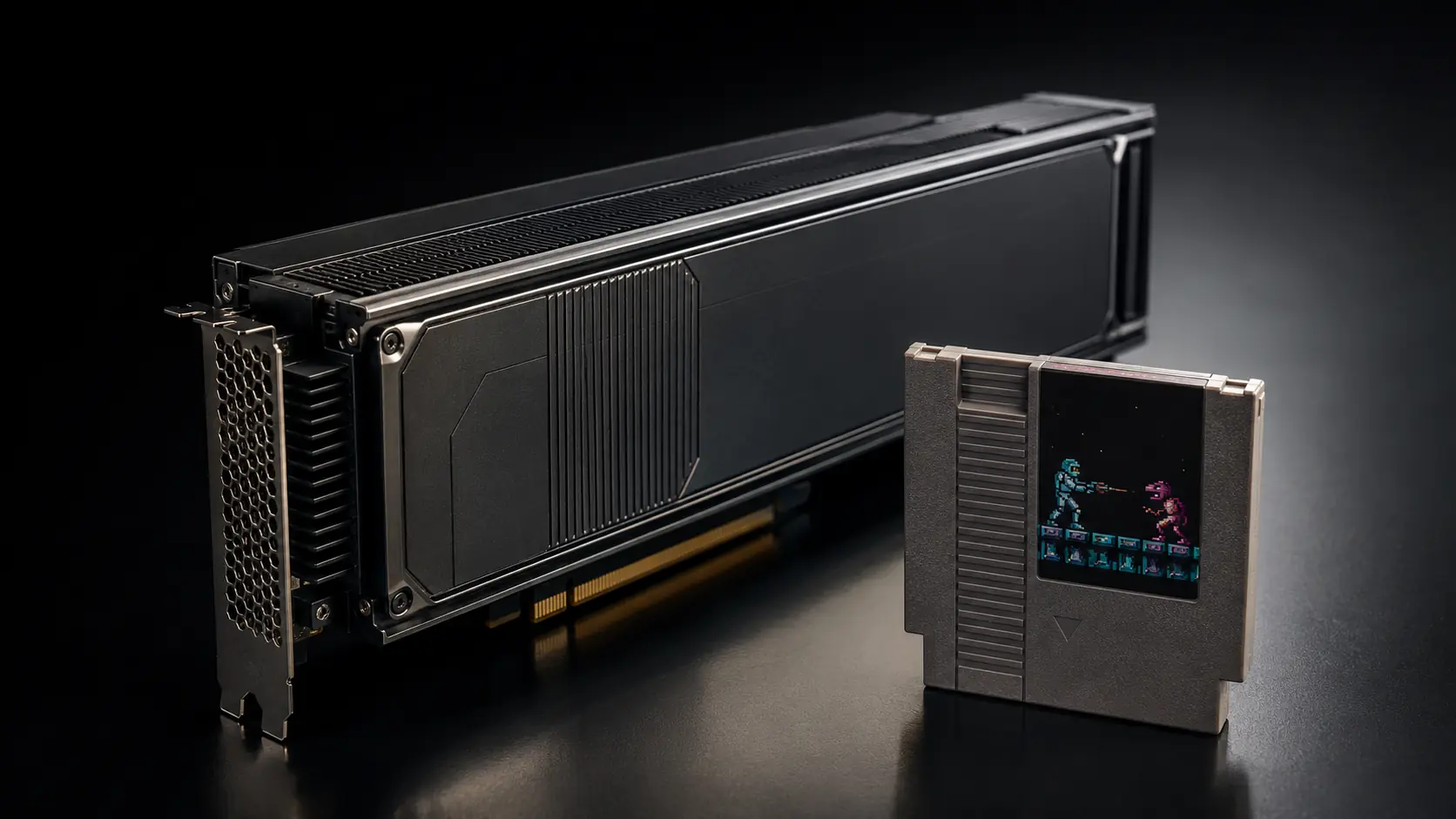
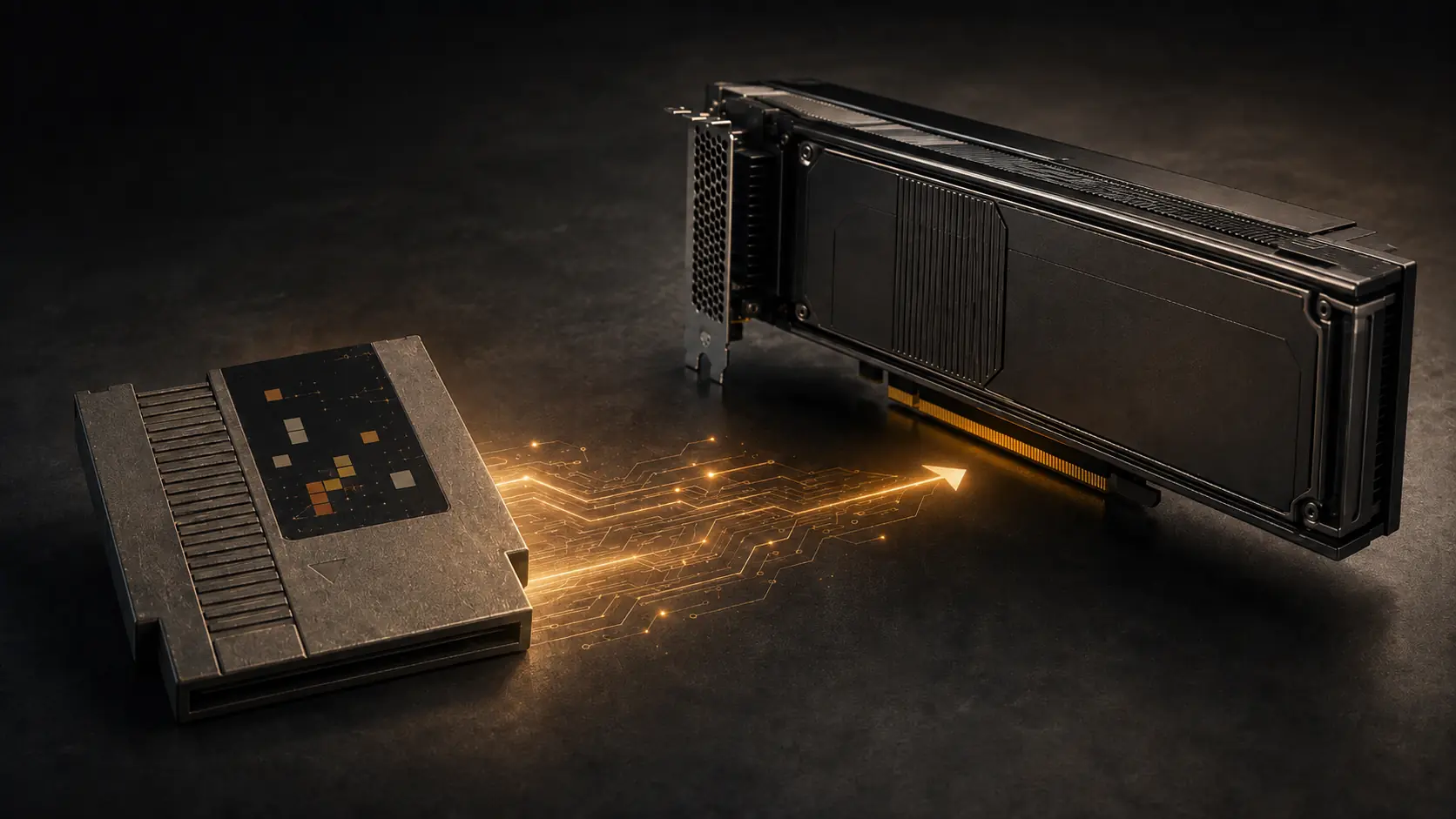
Taalas calls its approach a Hardcore Model. Its HC1 chip uses a mask-ROM-based fabric to hold the model weights and physically specializes the dataflow around them. It merges storage and computation instead of maintaining the normal wall between a processor and external memory. There is still programmable SRAM for things that actually need to change, including the KV cache and LoRA adapters, but the base model itself is built into the chip. For a normal person, it is roughly a game cartridge with the model built into it and a save function for the things that still need to change.
According to Taalas, the architecture can store a four-bit model parameter and perform its associated multiplication with one transistor. The implementation is fully digital, not analog compute or some laboratory experiment that only works when Mercury is in retrograde.
The first HC1 is manufactured on TSMC’s N6 process, measures 815 square millimeters and contains 53 billion transistors. One chip holds the complete Llama 3.1 8B model. A card consumes roughly 250 watts, and Taalas places ten of them in a conventional air-cooled 2.5 kW server. No HBM. No liquid cooling. No elaborate scale-up fabric required to make the individual model work. Taalas lists the core HC1 specifications here.
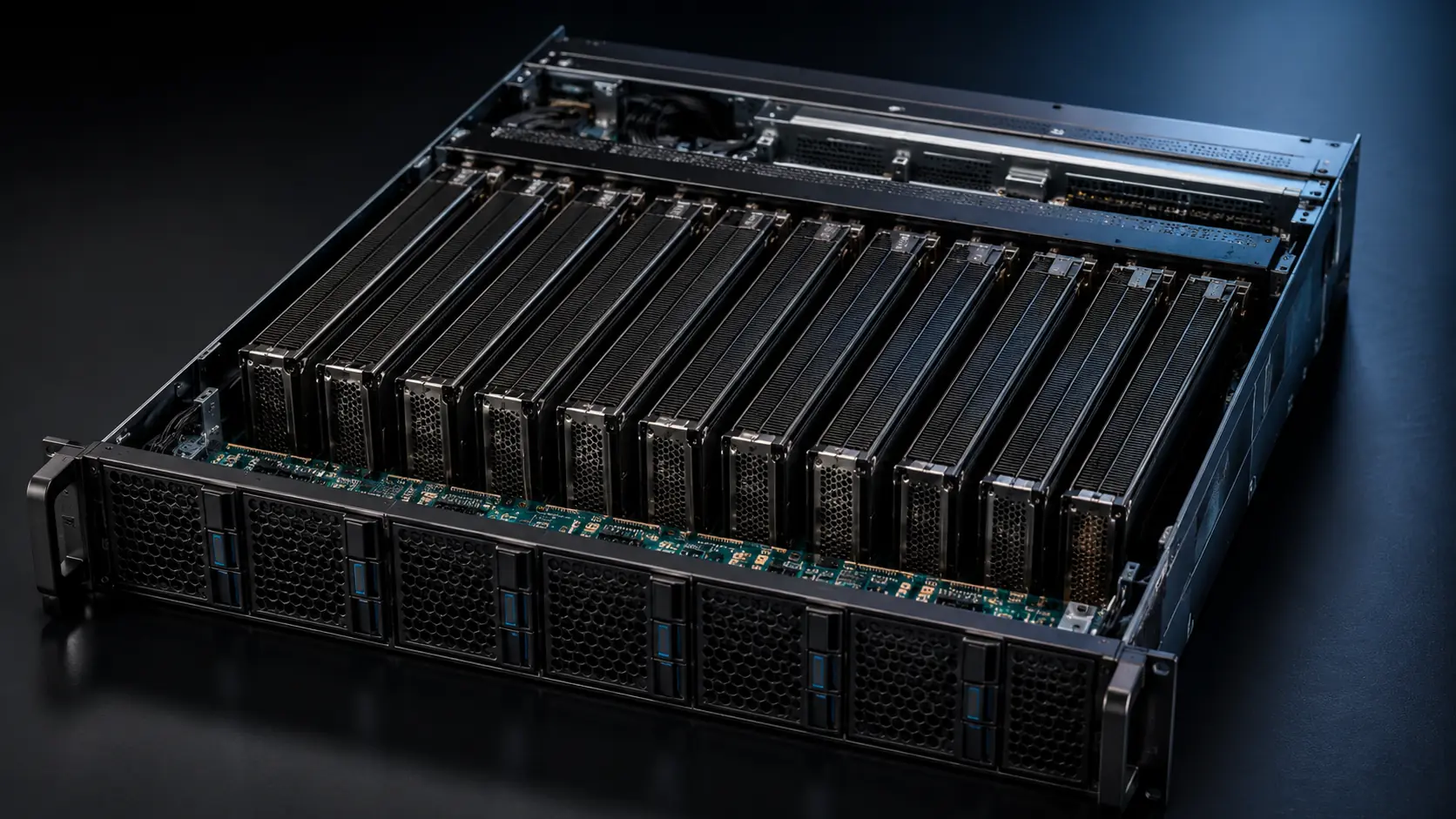
For the normal people reading: the ten-card server draws 2,500 watts, which means it pretty much has to connect where your electric or induction stove connects. It is also a 2,500-watt space heater. If you have ever used a home electric heater, they usually max out at 1,500 watts. Useful if you are an Eskimo. Also, if you are an Eskimo running data-center equipment...You sound interesting and I want to meet you!
Anyway, it is still serious data-center equipment at this point. However, compared with the infrastructure we are assembling to serve AI today, it is radically simple. Taalas CEO Ljubisa Bajic described one especially funny consequence of that simplicity: software more or less disappeared. The company reportedly has one person working part-time on the software stack.
After spending the last two months fighting Python dependencies, runtimes, GPU architectures, model formats, inference engines, middleware and user interfaces, I have just a few bones to pick with software.
This is physical AI too
When people talk about physical AI, they usually mean robots, self-driving cars, industrial automation and machines that can finally interact intelligently with the real world. Look...I want my personal Johnny Five too. There are enormous possibilities in robotics. Manufacturing, transportation, health care, logistics, dangerous industrial work, personal assistance...all of it is real, and all of it is coming. It just is not the physical AI development that interests me most at this exact moment.
The robot may not be the first part of AI to become physical. The model itself might be. The model is no longer merely instructions being executed by a computer. A particular intelligence becomes a manufactured object. That is a much different idea than another humanoid robot doing backflips.
There are a ton of catches
HC1 runs Llama 3.1 8B. That is not simply the model Taalas decided to load this week. It is the model the chip was manufactured to run. You cannot wake up tomorrow, decide that Qwen is better and download new weights. You cannot replace Llama with DeepSeek. You cannot install whatever model was released while you were eating breakfast. You need new silicon.
The chip has more flexibility than the phrase “etched into silicon” initially suggests. Context length remains configurable. Its SRAM supports the changing KV cache. LoRA adapters can fine-tune the base model for particular tasks or organizations. But a LoRA does not turn Llama 3.1 8B into a completely different foundation model. The base remains the base.
The model is also not remotely frontier-class. Llama 3.1 8B is a useful small model released in 2024. It was selected because it was open, practical and small enough to prove the architecture on a single chip. It is aggressively quantized as well. HC1 uses a custom combination of three-bit and six-bit parameters, and Taalas openly acknowledges measurable quality degradation compared with higher-precision GPU deployments. Its second-generation architecture is supposed to move to standardized four-bit floating-point formats and improve density.
So...no...Taalas did not make GPUs obsolete.
It proved that giving up almost all programmability can produce an absurd increase in inference speed and efficiency.
That is a very different claim. It is also the more interesting one.
Silicon is permanent. AI changes before lunch.
The obvious objection is that AI models are moving much too quickly to manufacture them.
I have probably been through 50-plus models in the past two months. Things move extremely fast right now, and the idea of selecting one model today, freezing it into hardware and committing to run it for a year seems far from ideal. Model architectures and fine-tuning methods are still in their infancy, but maybe a year from now? I don't have the answer to that.
Taalas attempts to solve part of that problem with speed. It is not building a completely new processor architecture for every model. Its reusable platform changes only two masks to alter both the model weights and dataflow. The company says its automated process can take a previously unseen model to RTL in approximately a week and produce deployable model-specific hardware in roughly two months.
Two months.
Yes - you read that right. Two months is astonishingly fast for custom silicon.
It is also long enough for three new models to appear, a benchmark leaderboard to be rewritten and Reddit to declare the original model unusable garbage despite praising it as the second coming of Christ six weeks earlier.
For people like me, that is a problem.
For the real initial market, it may not matter.
The immediate market is scale
The first serious use case is obviously not somebody walking into Micro Center and browsing a shelf of Llama cartridges. It is scale.
If a hyperscaler, telecom company, automaker or large enterprise intends to run the same base model trillions of times, manufacturing that model directly into silicon begins to make sense.
The model does not need infinite flexibility. It needs to be fast, efficient, predictable and cheap to operate.
A telecom company may deploy one carefully validated model for a narrow set of network operations. An automaker cannot replace production vehicle software every morning because a new benchmark result appeared overnight. A factory may care much more about deterministic performance, power and reliability than whether its model is fashionable on Hugging Face. A high-volume coding assistant or customer-service platform can save extraordinary amounts of money by keeping a stable base model in production for a year.
I deal with a variety of customers who have equipment running that hasn't been touched in over a decade. If it works, is stable and does its job, why replace it?
This is where Taalas’s trade becomes rational. You give up the ability to run everything. In exchange, the one thing you chose runs insanely fast and economically.
Taalas has simulated a much larger system for DeepSeek R1 671B. It estimates that roughly 30 model-specific chips could run the model at approximately 12,000 tokens per second per user and 7.6 cents per million tokens. Those are projections, not demonstrated hardware. The 8B Llama chip exists. The 671B DeepSeek system does not.
Still, the simulation shows the direction. Taalas is not thinking only about tiny edge models. It believes the architecture can scale to frontier-sized systems by spreading the model across multiple custom chips. The economic assumption underneath the entire design is simple: the customer must be willing to commit to the model for about a year.
Many customers will not. Some will be like me and change the model, get frustrated that it is being stupid, switch models again, and only then realize I forgot to update the kwargs in the launcher. Some absolutely will be the target audience and run one model for a year.
AMD made me feel smart
I discovered Taalas a couple of weeks ago and started thinking through what model-specific silicon might mean. I was going to write this article before the acquisition. At that point, the story was a clever startup, an incredible proof of concept and a strange hypothesis about where it might lead.
Then, on August 6, AMD announced a definitive agreement to acquire Taalas.
Half the time, I feel like a drunk guy trying to find the bathroom in the club: determined, but clearly with no idea which direction is the right one. I may have been onto something here, though.
The acquisition does not prove that Taalas will successfully scale this architecture. It definitely does not prove my later cartridge theory. It does show that AMD believes the underlying technology and engineering team matter enough to pull into its long-term AI roadmap.
AMD was also fairly direct about the intended first move. It said Taalas will complement Helios rack-scale systems, Instinct GPUs, EPYC CPUs, ROCm and the rest of AMD’s AI ecosystem. It plans to integrate the technology into its accelerator roadmap and build system-level solutions alongside Instinct GPUs. That sounds like a hybrid architecture, not a replacement for GPUs. The programmable accelerators remain. They handle training, new models, changing workloads, experimentation, prefill and everything else that still requires flexibility. Model-specific silicon handles stable inference where latency, power and operating cost dominate.
There are other interesting possibilities. A small hardwired model could act as a speculative decoder for a larger model. Specialized chips could handle repeated pieces of multimodal pipelines. An enterprise could combine a programmable foundation model with fixed models for coding, routing, security or domain-specific work. Edge systems could run stable intelligence without hauling an entire general-purpose GPU software stack into every car, factory, camera or appliance.
AMD already knows how to do semi-custom silicon at massive scale. The company has spent decades building processors and SoCs for consoles, embedded systems and very large customers. Taalas brings a way to treat the model itself as the semi-custom workload.
That combination is why I think the acquisition may be a much bigger deal than buying another AI accelerator startup.
NVIDIA’s moat is not simply that it makes fast GPUs. It has an enormous software ecosystem built around CUDA. AMD has spent years trying to close that gap while also building competitive hardware.
Taalas offers another path.
If you specialize the hardware so completely that most of the software stack disappears, you do not have to recreate every layer of CUDA to run that model.
That is one hell of a way to approach a software disadvantage.
I think we may go back to cartridges
So now that we are done being sane and reasonable, we can move on to the fun stuff.
If AMD can make model-specific silicon economically for hyperscalers, telecom companies, automakers and enterprises, what happens when that capability eventually moves downmarket?
I think we may go back to cartridges. Not metaphorical software cartridges. Actual hardware.
Think about the old Nintendo sitting under your television. You did not download Mario into a general-purpose compute environment, install a runtime and spend three days discovering that one Python dependency hated another Python dependency.
You bought Mario. You pushed the cartridge into the machine. Mario was now available.
Now replace Mario with DeepSeek/Qwen/ChatGPT.
One card contains the base model. Another contains a vision model. Another contains a coding model or a private corporate model. You plug it into a standard host, give it programmable memory for context and customization, and that is where the intelligence runs.
No downloading hundreds of gigabytes of weights. No choosing between CUDA, ROCm and Vulkan. No finding the one inference engine that supports your model’s architecture but not its vision projector. No waking up to discover that PyTorch has started a blood feud with your installed compiler.
You install the intelligence the same way you installed Mario.
To be clear, AMD has announced absolutely nothing resembling a consumer model cartridge. This is my hypothesis, and there are a great many reasons it may never happen.
Fabricating model-specific silicon only makes economic sense at sufficient volume. Models currently change too quickly. Most people will not spend meaningful money on hardware that becomes obsolete when a better model ships. Licenses may prevent popular commercial models from ever being sold this way. Larger models require multiple chips. Consumers still need some surrounding compute, memory, storage and I/O. A physical product also has manufacturing, inventory and distribution costs that software avoids.
The first commercial systems will almost certainly be data-center infrastructure, edge appliances and embedded platforms...not a $299 Qwen card hanging beside the gaming GPUs at Best Buy.
But none of that makes the idea impossible forever.
AMD does not need to produce a unique low-volume chip for every model somebody uploads to Hugging Face. It needs a few models stable and popular enough to justify mass production. The physical form does not have to be a literal plastic cartridge. It could be a PCIe card, an M.2-like module, a chiplet, a soldered appliance or part of a future APU.
The important idea is not the shape.
The important idea is that the model becomes a product you physically install.
If the same base model serves millions of people for several years, manufacturing it may be cheaper than continuing to move its weights through general-purpose hardware forever. If a smaller model becomes a common local assistant, coding engine or vision system, a fixed-function module could offer instantaneous performance without a 600-watt GPU and the software circus surrounding it.
We already buy specialized hardware for graphics, networking, storage, video encoding and security. Buying specialized hardware for a particular intelligence is strange only because the models have never remained still long enough for us to imagine it.
Maybe they eventually will.
The model becoming physical
Robots will become physical embodiments of AI. That part is obvious.
I still want Johnny Five.
What I had not considered until I found Taalas was that the model itself might become physical first.
We have spent the last several years treating intelligence as software and running it through increasingly absurd piles of general-purpose hardware. More GPUs. More HBM. More cables. More power. More cooling. More layers of software trying to keep the entire thing working.
Taalas went in the opposite direction.
Pick the intelligence. Manufacture it. Run it at 17,000 tokens per second.
The current chip is an aggressively quantized 8B proof of concept. It cannot become a different model. The larger-system claims remain simulations. The economics require scale and commitment in a market currently defined by constant change.
Those are not footnotes. They are the entire risk.
But the thing works.
It worked well enough for AMD to buy the company before I finished writing about it.
Apparently, I was not the only person looking past the robot and wondering what happens when the intelligence itself becomes hardware.
Maybe the future of physical AI looks like Johnny Five.
Or maybe...before Johnny Five arrives...we all start buying cartridges again.